How to Protect Your Social Media Accounts from Being Hacked

Social media has become an important part of everyday life. Platforms such as Facebook, Instagram, LinkedIn, TikTok, and X allow us to communicate, share photographs, build professional networks, and stay connected with friends and family.

Unfortunately, these accounts are also attractive targets for cybercriminals.

A compromised social media account can be used to impersonate you, scam your contacts, steal personal information, distribute malicious links, or gain access to other online accounts. Fortunately, a few simple security practices can significantly reduce the risk.
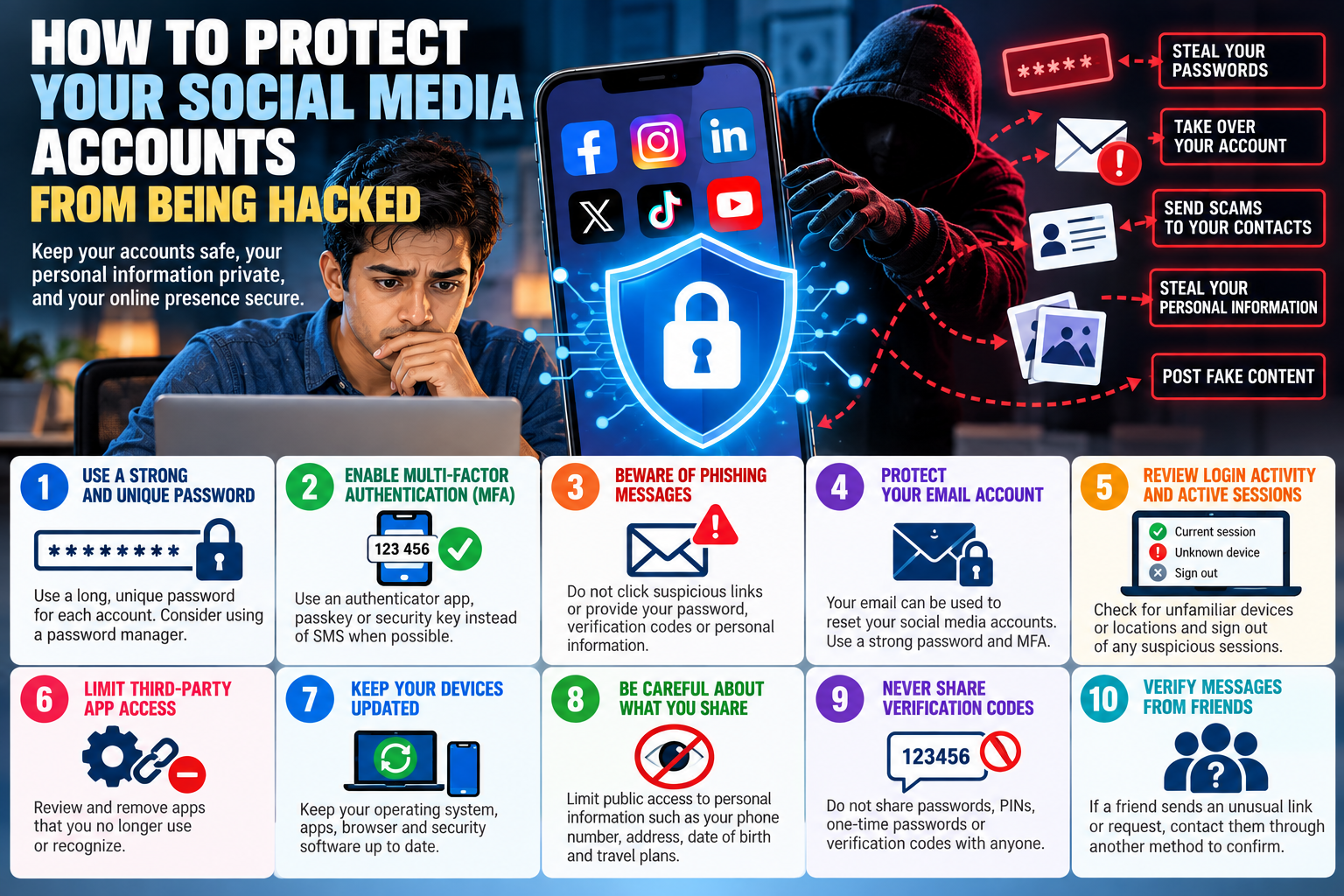
1. Use a Strong and Unique Password

Never reuse the same password across multiple social media accounts.

If attackers obtain a reused password from a breach involving one service, they may try the same credentials on other websites—a technique known as credential stuffing.

Use a long, unique password or passphrase for every account. A reputable password manager can generate and securely store unique passwords so you do not have to remember all of them.

2. Enable Multi-Factor Authentication

Multi-factor authentication (MFA), also called two-factor authentication or 2FA, provides an additional layer of security beyond your password.

Even if an attacker obtains your password, MFA can prevent them from accessing your account without the additional authentication factor.

When available, consider using an authenticator app, passkey, or hardware security key rather than relying solely on SMS verification. Security keys and other phishing-resistant authentication methods can provide particularly strong protection against account takeover.

3. Beware of Phishing Messages

One of the easiest ways to steal a social media account is simply to convince its owner to hand over the password.

Be suspicious of messages claiming:

  • “Your account will be suspended.”
  • “Someone reported your account.”
  • “Your account violated our policies.”
  • “Your page is eligible for verification.”
  • “Click here to verify your identity.”
  • “We detected suspicious activity.”

Instead of clicking a link in an unexpected email, text, or direct message, open the official social media application or manually visit the service and check your account notifications.

Never provide your password or MFA verification code in response to an unsolicited message.

4. Protect Your Email Account

Your email account is effectively a master key for many of your online accounts.

If someone compromises your email, they may be able to request password resets for your social media accounts and intercept the recovery messages. The FTC specifically warns that compromising an email account can allow an attacker to reset passwords for other accounts.

Protect your primary email account with a strong, unique password and MFA.

5. Review Active Sessions and Login Activity

Most major social media platforms provide information about devices or sessions currently logged into your account.

Review this information periodically.

If you see an unfamiliar device, browser, or login location, terminate the session and change your password immediately.

Enabling notifications for suspicious or new logins can also provide an early warning that someone is attempting to access your account. The Canadian Centre for Cyber Security recommends reviewing recent activity, connected devices, applications, and account-access notifications.

6. Limit Third-Party App Access

Remember that applications connected to your social media account may also have access to some of your information.

Periodically review:

Settings → Security/Privacy → Apps or Connected Applications

Remove applications and services that you no longer use or recognize. CISA recommends limiting third-party application access as part of protecting social media accounts.

7. Keep Your Devices Updated

Your account security also depends on the security of the device you use to access it.

Keep your:

  • Smartphone operating system
  • Computer operating system
  • Web browser
  • Social media applications
  • Security software

up to date.

Software updates frequently contain fixes for security vulnerabilities. Enabling automatic updates can help ensure important patches are installed promptly.

8. Be Careful About What You Share

Cybercriminals can collect information from social media to create convincing phishing attacks or attempt account recovery.

Consider limiting public access to information such as your:

  • Phone number
  • Email address
  • Date of birth
  • Home address
  • Workplace details
  • Family information
  • Travel plans

Review your privacy settings regularly and decide who should be able to see your posts and personal information.

9. Never Share Verification Codes

If someone contacts you and asks for a verification code that was just sent to your phone or email, do not provide it.

That code may be the final authentication step an attacker needs to access your account.

Treat passwords, recovery codes, one-time passwords, and MFA codes as confidential information.

10. Watch Out for Friends Whose Accounts Have Been Hacked

A message coming from someone you know is not automatically trustworthy.

If a friend suddenly sends you an unusual link, investment opportunity, request for money, or message asking for a verification code, contact that person through another method before responding.

The FTC specifically recommends independently checking with friends when unexpected financial or suspicious messages arrive through social media because their account may have been compromised.

What Should You Do If Your Account Is Hacked?

Act quickly.

Use the platform’s official account-recovery process and change your password as soon as you regain access. Sign out other devices, enable MFA, verify your recovery email address and phone number, and inspect the account for unauthorized posts, messages, connected applications, or changes to security settings.

If you reused the compromised password anywhere else, change those passwords as well.

Inform your contacts that your account was compromised so they know not to trust suspicious messages that may have been sent from it.

Conclusion

Protecting your social media accounts does not require advanced cybersecurity expertise.

The most important steps are straightforward: use unique passwords, enable strong MFA, secure your email account, keep your devices updated, review login activity, and be extremely cautious with unexpected links and messages.

Cybercriminals frequently target the person rather than the technology. A convincing phishing message can sometimes defeat security measures simply by persuading someone to reveal their credentials.

Before clicking a link, entering a password, or approving a login request, stop and ask yourself:

Did I initiate this action, and do I know that this request is legitimate?

A few seconds of verification can prevent weeks or months of dealing with a compromised account.
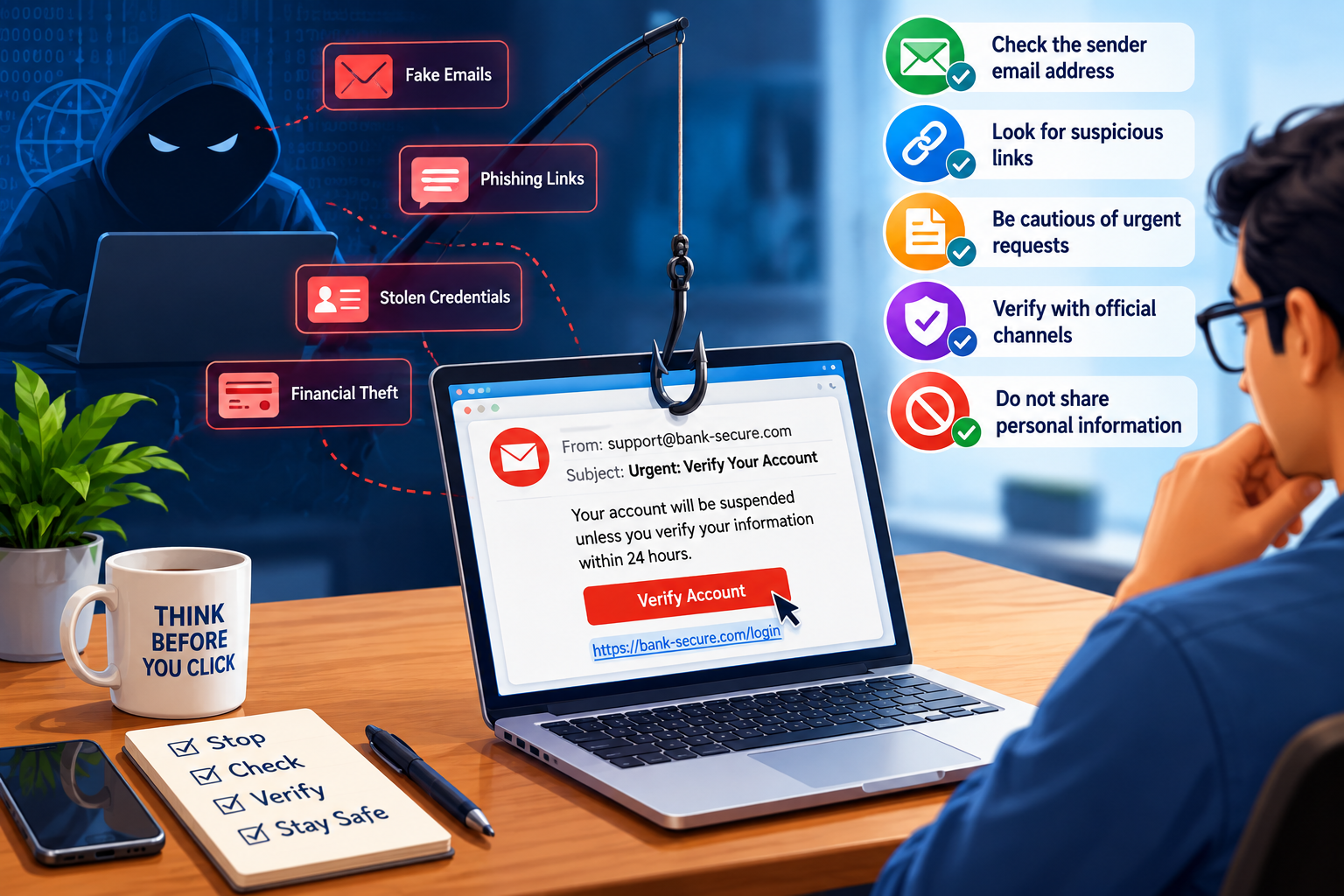
How to Protect Yourself from Phishing: Think Before You Click

Phishing remains one of the most common ways criminals attempt to steal passwords, financial information, and other sensitive data. Instead of directly attacking a computer, phishing attacks often target the person using it.

A phishing message may impersonate your bank, employer, delivery company, government agency, streaming service, or even someone you know. The objective is usually simple: convince you to click a malicious link, open an attachment, disclose credentials, approve an authentication request, or send money.

Modern phishing can also be highly convincing. Good spelling and professional-looking graphics are no longer reliable indicators that a message is legitimate. The FTC warns that phishing commonly uses stories about suspicious account activity, payment problems, unexpected invoices, refunds, or requests to confirm personal information.

1. Be suspicious of urgency

One of the strongest phishing techniques is creating a sense of urgency:

“Your account will be suspended.”
“Payment failed—update your information immediately.”
“Someone logged into your account.”
“Your package cannot be delivered.”

Urgency encourages you to react before verifying the message. The FTC identifies pressure to act immediately as a common characteristic of scams. Consumer Advice

When a message creates fear, excitement, or urgency, slow down and verify it independently.

2. Don’t automatically trust the sender

A familiar display name or company logo does not prove that a message is genuine. Attackers can impersonate organizations and individuals.

Check the complete sender address rather than only the displayed name. Watch for misspelled domains, unexpected addresses, unusual reply-to addresses, and domains designed to resemble legitimate ones.

Also remember that a legitimate-looking message can sometimes originate from a compromised account.

3. Don’t click unexpected links

Treat links in unexpected emails, texts, social-media messages, and messaging apps cautiously.

Instead of clicking a message claiming there is a problem with your bank or another account, open the company’s official app or enter its known website address yourself. The FTC similarly recommends contacting an organization using a website or telephone number you know is genuine rather than information contained in the suspicious message. Consumer Advice

The same principle applies to QR codes. A QR code is effectively another way of directing you somewhere online, so don’t assume it is trustworthy simply because you cannot immediately see the destination.

4. Never disclose passwords or verification codes

Be extremely cautious when someone unexpectedly asks for:

  • Passwords or PINs
  • Credit-card or banking information
  • One-time verification codes
  • Account recovery codes
  • Personal identification information
  • Authentication approvals

A particularly important rule is never give another person a one-time authentication code because they asked for it.

5. Use unique passwords and a password manager

Every important account should have a strong, unique password.

Reusing passwords creates a dangerous domino effect: if one account is compromised, attackers may attempt those credentials against other services.

A reputable password manager can generate and store long, random passwords so you don’t have to remember every password yourself. CISA also recommends long, strong, unique passwords and using a password manager. CISA

6. Enable multi-factor authentication

Multi-factor authentication (MFA) provides an additional barrier if an attacker obtains your password.

Where available, consider phishing-resistant authentication, such as passkeys or hardware security keys, especially for critical accounts. CISA notes that not all MFA methods provide the same protection and recommends phishing-resistant MFA as the strongest form. CISA

At minimum, enable MFA on your email, banking, cloud-storage, social-media, shopping, and other sensitive accounts.

7. Never approve an unexpected MFA request

Attackers who already know your password may repeatedly send authentication requests hoping that you eventually tap Approve.

If you receive an authentication request when you aren’t signing in, deny it. Then investigate the account, change the password if appropriate, and review recent sign-in activity.

An unexpected authentication prompt can itself be a warning that someone is attempting to access your account.

8. Keep your devices updated

Keep your computer, smartphone, browser, security software, and applications updated. Enable automatic updates wherever practical.

Security updates address vulnerabilities that malicious websites, attachments, or software could potentially exploit. The FTC recommends keeping security software and operating systems automatically updated as another layer of protection. Consumer Advice

9. Verify unusual requests through another channel

Suppose you receive an email apparently from your manager asking you to purchase gift cards, a family member urgently requesting money, or a supplier unexpectedly changing banking details.

Verify the request independently.

Call the person using a number you already know, speak to them directly, or contact the organization through an established channel. Do not rely solely on contact information supplied in the suspicious message.

This becomes increasingly important as impersonation techniques become more sophisticated.

10. Know what to do if you clicked

Accidentally clicking a phishing link doesn’t mean you should ignore what happened.

If you entered a password, change it immediately and change it anywhere else you reused it. Enable MFA, review active sessions and recent account activity, and sign out unknown devices. If you downloaded something suspicious, update your security software and run a security scan; this is also recommended by the FTC. Consumer Advice

If financial information was disclosed, contact the relevant financial institution promptly.

The most important habit: Stop, verify, then act

Technology such as spam filtering, secure DNS, endpoint protection, password managers, passkeys, and MFA can dramatically reduce risk, but phishing ultimately tries to persuade you to make a decision.

Before clicking, downloading, paying, authenticating, or providing information, ask yourself:

Was I expecting this message? Who is really asking me? Why do they need this information? Can I verify the request independently?

Conclusion

Phishing attacks succeed by exploiting trust, urgency, curiosity, and fear. Your strongest defense is therefore a combination of technology and awareness.

Use unique passwords, enable MFA or passkeys, keep your devices updated, avoid unexpected links and attachments, and independently verify unusual requests. Most importantly, never allow an unexpected message to pressure you into making an immediate security or financial decision.

A few seconds of verification can prevent a compromised account, financial loss, malware infection, or identity theft.

When in doubt: don’t click—verify.

For additional guidance, see the FTC’s guide to recognizing and avoiding phishing scams and CISA’s phishing security guidance.